What makes a miracle?
Any parent who’s successfully navigated bedtime without an argument could argue that’s pretty miraculous.
Drivers traversing I-465 around Indianapolis unencumbered can feel like they’ve experienced a miracle, too.
But real miracles, like those attributed to Saint Mother Theodore Guerin — Indiana’s only saint — are harder to come by, and even harder to prove.
As the Sisters of Providence of Saint-Mary-of-the-Woods congregation honors their foundress on the 20th anniversary of Guerin being named a saint, its members say her teachings aren’t ancient history, but instead have meaningful relevance in today’s world.

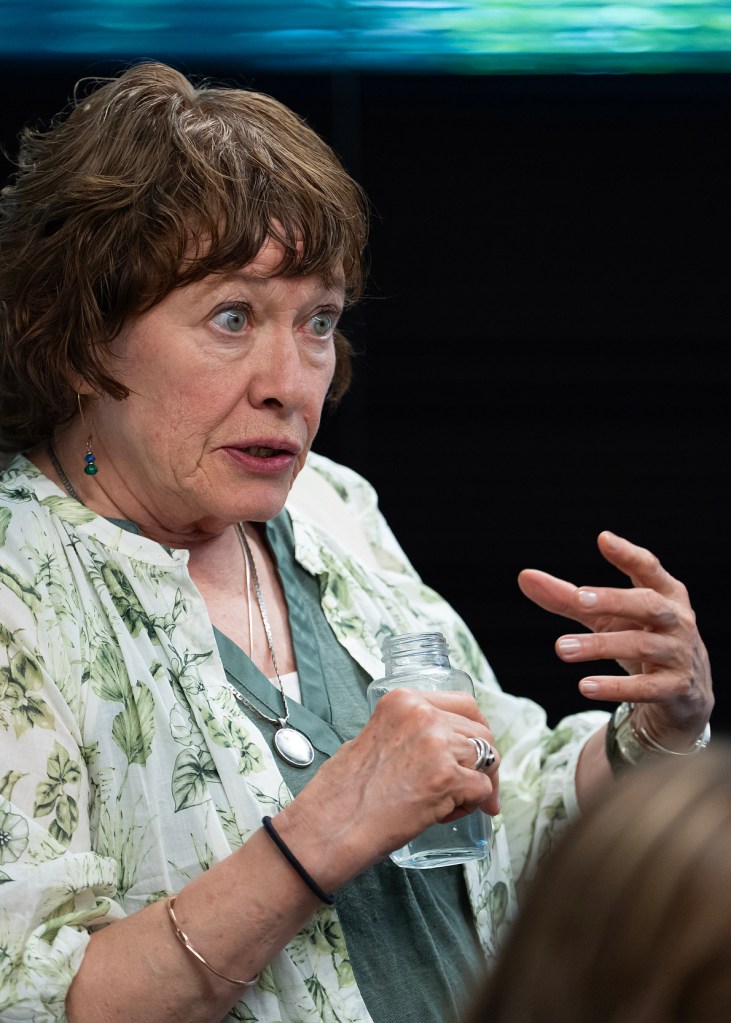
“She’s such an example of strength and courage in uncertain times,” said Sister Paula Damiano, who joined the order 59 years ago. “The times in which she lived, it was right after the Napoleonic Wars … things were in chaos.”
Fought from 1803 to 1815, the Napoleonic Wars — named for French Emperor Napoleon Bonaparte — were a series of conflicts pitting France against various European coalitions. The wars ended with Bonaparte’s defeat at the Battle of Waterloo in 1815.
Before she was 15, Guerin’s father, who had served under Bonaparte during the wars, died. Her two brothers died, one in a house fire, the other due to injuries sustained in a separate fire incident in the home. The deaths left her mother distraught, and Guerin ended up as caretaker for her grieving mother and younger sister.
“She said, ‘All I can do is trust in God,’” Damiano said of Guerin’s mindset in those challenging years. “I say to people that’s an example for us all.”
Coming to Indiana
After so much loss in the family, Guerin’s mother opposed her oldest daughter pursuing religious life. It took five years, but Guerin ultimately persuaded her mother to let her join the Sisters of Providence at Ruillé sur-Loir, in northwestern France.
She was trained first to be a teacher, and then studied medicine to become a nurse after she was sent to a remote part of France to work with the poor. Eventually, word reached France that the bishop in Vincennes, Indiana, wanted nuns to come teach the children of the pioneers living there, and in 1840 Guerin was one of six who answered that call.
The women endured a stormy ocean crossing, widespread illness and were robbed of much of the money that had been intended to build the community. And once the community had been established, arsonists burned the sisters’ work to the ground.

Still, despite all the hardships, Guerin and her team ultimately established their convent, Saint-Mary-of-the-Woods College for women, at least 10 parish schools in parts of Indiana and Illinois and two orphanages.
“We love to tell her story,” Damiano said. “We just love to.”
Unintended sainthood
The issue of confirming whether or not a miracle occurred is a long, very detailed process within the Catholic Church.

Here’s what it looks like, in very oversimplified terms: At least five years after a person’s death, a local bishop can initiate an investigation into a person’s life and the miracles that may be attributed to him or her.
Next, a local team investigates the alleged miracle, working to rule out a natural or scientific circumstance that could explain whatever instance has occurred.
In time, if no explanation is found, the local team transfers their learnings to a special group from the Vatican that explores not only the alleged miracles, but examines in deep detail the life of the person to whom the acts are being credited.
The church requires two verified miracles for a person to be considered for sainthood.
The process takes years, if not decades, and isn’t something the church takes lightly.
Two miracles are attributed to Guerin.
Prayers for a friend
The first verified miracle occurred more than 100 years ago, when one of the Sisters of Providence visited Guerin’s grave to pray for a sick friend.
But that nun herself was unwell.
“She had cancer of the stomach,” Sister Jan Craven said. It was so acute, the nun had to wear a special habit (traditional, uniform clothing for nuns) that had been made in such a way to accommodate the woman’s tumors.
“She prayed for her friend who was sick, but she also said she had great confidence and trust in Mother Theodore,” Craven said.

The nun with cancer later said she hadn’t prayed for healing for herself.
But that didn’t mean she didn’t believe that it was possible.
“The next morning, (the nun with cancer) got up to put her skirt on and it fell off her,” Craven said.
The tumors were gone.
“She was cured of cancer,” Craven said.
Reading again
But Guerin’s miracles aren’t all ancient history.
In 2000, the congregation’s longtime maintenance engineer began losing his sight.
After some surgeries and medical care, Phil McCord was eventually told by doctors at the time that his condition was untreatable, and blindness was only a matter of time.

“Phil was the son of a Baptist preacher, and Phil himself was a Baptist,” Damiano said. “One day he went into the church and said, ‘I don’t know much about this saint stuff, but I believe you can do (miracles). Please talk to God and heal this blindness. I love your sisters and want to work for them.’”
A week later, McCord was sitting at the breakfast table and he picked up the morning paper and began reading it. Damiano said McCord’s wife noticed and asked why he would do such a thing. To her knowledge, her husband hadn’t been able to read a paper for some time.
“He said, ‘I can see it,’” Damiano said.
McCord’s miracle was written about extensively, and when Guerin’s canonization Mass and celebration were held in Rome, he was right there alongside Craven, Damiano and other women of the order, cheering like mad.
“Doctors said there was no human reason for his eyesight to be restored,” Damiano said. “But there he was. It was pretty spectacular. And the rest was history.”
Lessons for this century
The “headline” miracles, the women say, are unquestionably worthy of celebration.
Still, they said what they both love even more are what they call the “backstory” miracles.
“We call it the ‘gate effect,’” Cravens said.

Walking around the grounds, sitting quietly in the gardens, even just being still, can work wonders for a person in today’s hectic world, they said.
“People say they feel a sense of peace here, and I say, ‘Well, of course, this is holy ground. A saint walked here,’” Cravens said.
If you go
The Sisters of Providence of St. Mary of the Woods encourage guests to visit the shrine to Saint Mother Theodore Guerin.
- 🕰️ Open daily from 8 a.m.–5 p.m. (ET)
- 📍 Saint Mary-of-the-Woods, Indiana
- Enter through the main doors of Providence Spirituality & Conference Center, located at the end of The Avenue.
- 💸 Admission is free. Donations are accepted.
- 🗓️ To schedule a guided tour or pilgrimage, email tours@spsmw.org or call 812-535-2946.
When high school classes or other visitors are on the grounds, Cravens said she asks them to really reflect on who Guerin was, not just the works attributed to her.
“We ask (visitors) to consider how is my life like hers? How is her life like mine? She was a math teacher, she studied medicine, she lost her father through tragedy, she lost a sibling through tragedy. She was interested in business and entrepreneurialism, and she had a spirit of justice in her life that gave her the feeling she needed to right wrongs.
“Her life was strong and courageous. Mother Theodore had love for everyone and anyone, she was an immigrant, all her life she fought for immigrants. There is just so much about her life we could all relate to,” Cravens said.
Before social justice issues were widely discussed or even understood, Guerin wrote about them in her own journals.
“Yes above all things; justice, justice. If any preferences may be shown, let it be to the poorest or most abandoned,” Guerin wrote.
Damiano said Guerin’s unwavering conviction feeds her soul.

“For me, it’s reliance on something bigger than yourself. She relied on the providence of God. In our era, we are so self-focused, and that’s not necessarily a bad thing, but there is something else, something bigger. Whether it’s a cause you believe in, or whether it’s God, or whether it’s yoga, there should be something that will make you more reflective,” Damiano said. “That’s part of what we do is take her (spirit) out to people. We want to introduce her to people, and to get her message of love, of mercy, of justice, of compassion out.”
“We say act without distinction of persons. Do all for the glory of God.”
Lisa Renze is director of strategic partnerships for Free Press Indiana and an FPI News contributor. You can reach her at lisa.renze@freepressindiana.org.
FPI News, a nonprofit newsroom, is funded through grants and donations from individuals, foundations and organizations. Sign up for our free newsletter.