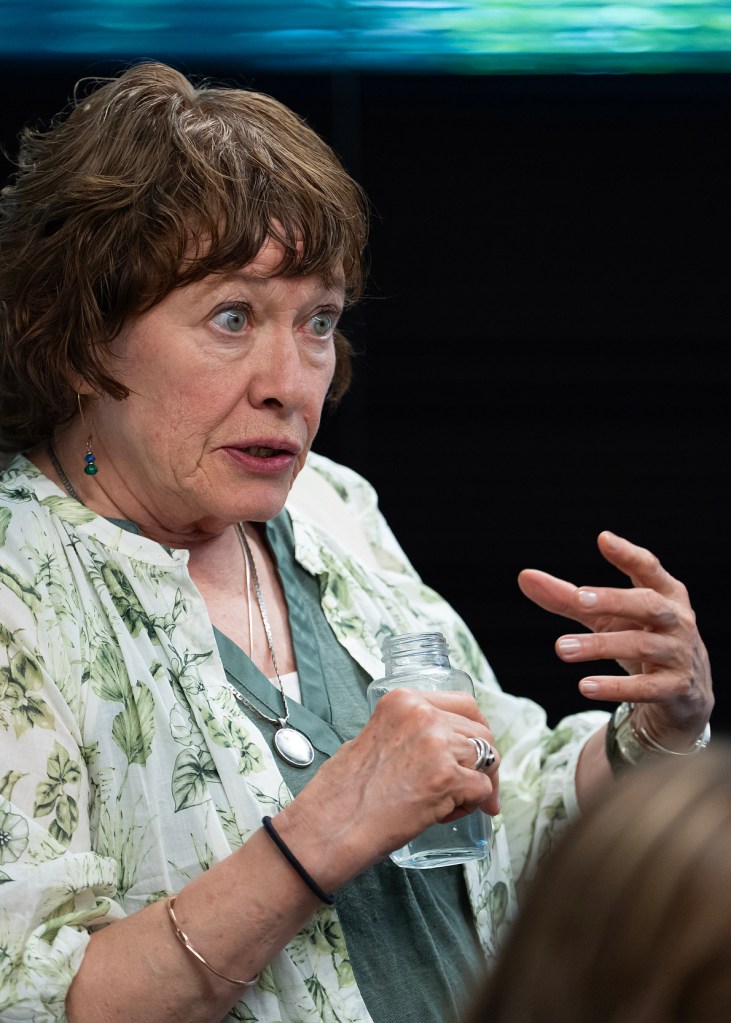
Kathy Morton’s daughter, Kai, a happy, easy baby, was 3 years old the day she made her voice heard.
“She had a language delay, and a sensitivity to light — she loved her sunglasses — but otherwise she was just a happy person,” Morton said.
Until the day they visited their local Walmart in Fort Branch, Indiana, near Evansville. Morton accidentally left Kai’s favorite comfort object, a small unremarkable burping towel, in the car.
Once Kai realized the cloth, unintentionally beloved due to its proximity during diaper-changing times, was missing, she let her mom know. The toddler began screaming at the top of her lungs.
“It was so out of character,” Morton said. “I just picked her up and headed back to the car, and once she had that towel again, she was fine.”
But the moment stuck in Morton’s mind, not because of the toddler’s outburst, but because of a pattern of behaviors that didn’t seem to matter, until they did.
The language delay.
The light sensitivity.
The “Walmart-Towel Incident.”
Individually, all could be considered normal behaviors. But combined?
“I just looked at her and said, ‘Message received.’”

That epiphany set the course for the rest of Morton’s life. She would become one of the 1.2 million adults in Indiana who provide care to a family member or friend with complex medical conditions or disabilities, according to the National Alliance for Caregiving. And as the result of the decades of care Morton has — and will continue to provide — she’s at a higher risk than non full-time caregiving moms of developing her own physical and mental health challenges.
For her part, Morton said recognizing her daughter may be different from other children her age didn’t initially worry her too much. She thought she had some idea of what lay ahead.
Now nearly 20 years later, Morton admitted, “I really had no idea what was coming.”
The road to support
Morton’s daughter was 12 when the symptoms of her mental illness became unmistakable.
“She was happy one day and someone else the next,” Morton said.
After a host of doctor’s appointments and assessments, Kai was diagnosed with autism spectrum disorder and obsessive-compulsive disorder. The diagnosis brought some understanding, but little relief.

When Morton’s former husband refused to believe their daughter had a disability, Kathy became Kai’s primary source of emotional support, her medical advocate, and many days, the one person standing between her child and death.
About once a month, in conjunction with hormonal fluctuations in her menstrual cycle, Kai struggled with suicidal ideation. Morton described one incident, sitting across from her daughter at the kitchen table with other family members present. The group was talking, laughing and enjoying themselves.
But Morton saw the moment shift.
“I watched the expression on (Kai’s) face change. And when she went to walk up the stairs, I felt like I needed to follow. I stopped her from jumping out of a window,” Morton said.
Despite the seriousness of the situation, Morton and her daughter found it difficult to advocate for medical assistance. After years of trying to find a doctor who would help, they finally found an expert to provide some support.
Now at 22, Kai is the most stable she’s ever been.
And Morton, now 62 and retired, is still her daughter’s primary caregiver. The path the pair has walked together has been far from easy, and while Morton has struggled with the constant weight and pressure of being a caregiver, her love for her daughter is unconditional.
“Sometimes she makes life a lot easier,” Morton said of Kai. “I love that she’s just no bullshit.”

Morton’s support system is a mix of faith, family and friends, most of whom are women, she said.
“Women are just…better at this,” Morton said. “It shouldn’t be that way, and I don’t think it has to be that way, but that’s what I’ve observed.”
Care for the caregivers
Being a parent of a child with a developmental disability can be a source of much joy and love, but also great anxiety and stress. And the toll is especially taxing on women. By age 65, women who provide full-time care for adult children show increased signs of anxiety and depression, psychological distress, more physical health symptoms, and other chronic conditions.
The challenge is exacerbated, experts say, because women also tend to dismiss their own needs — caregivers rarely take time to take care of themselves. Relief can come with small steps as simple as acknowledging that what they’re facing is daunting.
“(They should) give themselves permission to feel that this is a lot, because it is,” said Dr. Candace Westgate, a board certified OB-GYN with additional certifications in advanced laparoscopy, menopausal management and cancer genetics. Westgate is also the director of personalized medicine for Community Health Systems in Westfield, Indiana. “(Caregiving) is a major life stressor.”

Westgate is aware that for many caregivers, finding even 15 minutes a day to consider their own needs can be challenging. At the least, she encourages caregivers to make sure they are sleeping between seven and nine hours per night, when they can, which can be a rare opportunity for some.
“Sleep is one of our superpowers,” she continued. “Poor sleeping can lead to many health issues, one of them being heart disease.”
The numbers bear that out, even without the pressure of caregiving. Heart disease remains the leading cause of death for women, but according to the American Heart Association, only 22 percent of primary care doctors reported they felt “extremely well prepared” to assess cardiovascular risks in women. For cardiologists, that number is 42 percent.
Meanwhile, an estimated six in 10 women are in caregiving roles, according to a survey from the AARP and the National Alliance for Caregiving. In addition to being responsible for adult children, caregivers also commonly report they are caring for aging parents, or other older loved ones.
The pressure and privilege of caregiving
Such is the case for Whitestown resident Tanorria Askew Nickson, 44, who’s been caring for her mother, Frankie, since spring of last year.

The situation with her mom evolved as Nickson was still dealing with the death of her dad Eric D. Askew, in December 2024. What she thought would be a demanding one or two weeks of caring for her mother as she recovered from heart surgery, has continued now for eight months.
Nickson, who has a history of surviving domestic violence and the ensuing depression, fends off the worst of her stress and caregiving anxiety by leaning into community, which starts with the support of her husband, Johnny.
There have been seasons of progress as her mother was able to move from Tanorria’s home into assisted living, and recently, finally back to her own home. Tanorria still provides daily care and her assistance.
She said it’s easy to get lost in the day-to-day, doing everything required. The task list is neverending and it takes time to organize routines and find natural rhythms.
“In the beginning, you don’t take care of yourself because your brain is just off,” she said.

But at some point, real talk is required. Nickson said the best thing caregivers can do for themselves is be honest about where they are and what they need.
“Tell your family you’re running on 20%. People can’t see the weight on you. They don’t know how it feels to be able to consult anyone you want about somebody else’s medical decisions, while knowing that ultimately all the decisions fall on you no matter what.”
In addition to assistance from her husband, Nickson has an aunt who regularly demands she take care of herself.
“She came up two or three times from Tennessee, (telling) me she didn’t want to see my face in the hospital while she was there.”
This is an approach Westgate can get behind.
“When your friends or family members are caregiving, don’t send a text asking them if there’s anything you can do to help,” she said. “Just show up.
“Show up and say you’re here for two hours and they need to point out what you can do. Bring a meal that’s easy to freeze and eat later if they’ve already cooked that evening. Tell them, ‘I’m coming over once a week for two hours, you can either have a list of tasks ready for me to do, or you can leave for two hours while I sit with the person you’re caring for,’” Westgate said.

The American Heart Association provides additional resources for caregivers, echoing other experts who encourage providers to prioritize their own health. Among the tips, the AHA encourages caregivers to get regular physical activity, which can be as simple as a walk in the neighborhood.
Nickson realizes the unique gift she’s been given, in caring for her mom.
“I can’t imagine not having someone medically advocate for me the way I advocate for my mom,” she said.
But she’s smart about trying to find balance. She said she consistently is checking in on herself.
“Did I move my body today? My calves and legs are my second heart. I have to be strong there, too.”
This content is underwritten with support from the American Heart Association.
FPI News, a nonprofit newsroom, is funded through grants and donations from individuals, foundations and organizations. Sign up for our free newsletter.