In southern Madison County, hidden behind field corn nearly ready for harvest, Fall Creek Friends Meeting House sits unseen by drivers passing on State Route 38.
For more than 190 years, Quakers have gathered here for worship and fellowship. Grave markers in the cemetery on the grounds honor the families who established the community. The quiet land and ancient headstones pay tribute to a shared past that meeting house members recently learned was also harboring a secret.
About seven years ago, the church community invited an historical architect to survey their space as they were readying to apply for a grant to begin much-needed restoration and renovation projects on the current structure, which dates to 1857.
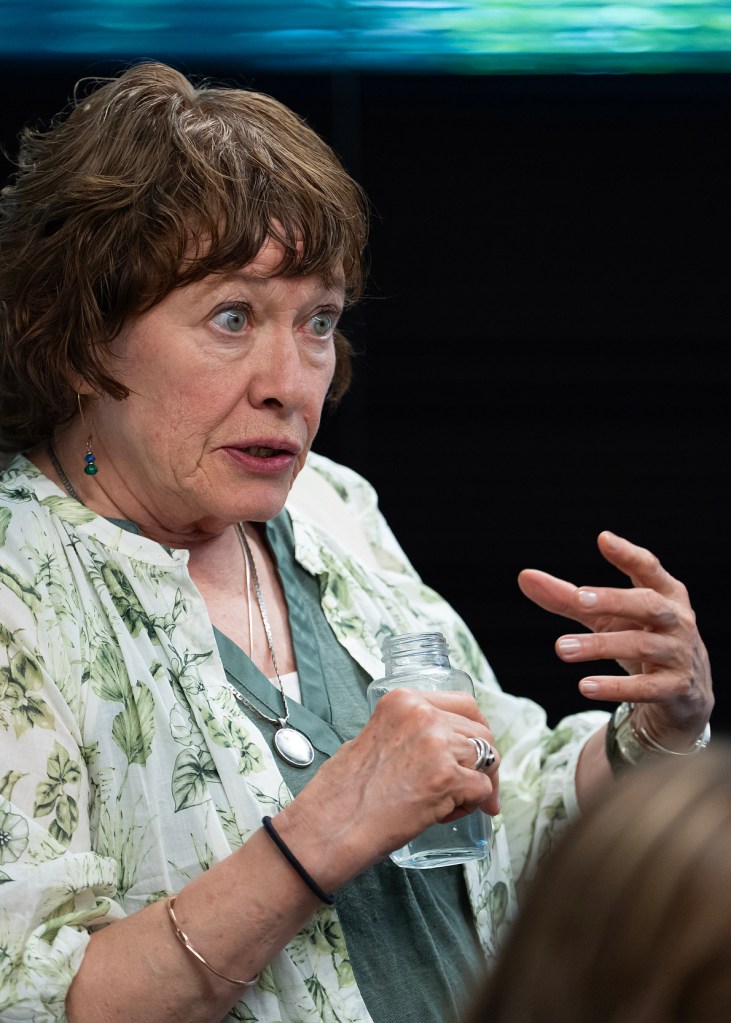
“He was walking around, looking inside and outside and all around, and he said, ‘Well, this is really odd. This inside wall does not meet the outside wall,’” house caretaker Diann Herzog said.


The architect did some digging, literally, and found a dirt and stone hole that’s roughly 4 by 3 feet, camouflaged underneath the hand-hewn hardwood planks in the large, main gathering space. The hidden hole then branches out into crawl spaces that bifurcate along the sides under the building.
The meeting house was a stop along the Underground Railroad.
“We were just floored,” Herzog said. “We were speechless.”
Truth to the tales
Community members had long heard rumors and stories about the meeting house’s potential ties to the Underground Railroad, she said, but this discovery and additional research confirmed it.
In the U.S., the Underground Railroad was a network of people and places that helped enslaved Blacks escape to freedom, beginning as early as the late 1700s and continuing through the end of the Civil War.
“If you get into it and start looking at Underground Railroad stops, a lot of them were facilitated by Quakers,” she said. “But it had to be by word of mouth. They couldn’t put things in writing, because it was so dangerous.”
So carrying messages, person to person, was the best way to try to ensure the safety of everyone involved.

Enter the practice of traveling ministers, who moved from congregation to congregation, engaging each community not only in spiritual pursuits, but Herzog believes moral actions as well.
Emma Lapsansky-Werner, professor emeritus of history at Haverford College in Pennsylvania, explained Quakers’ beliefs explicitly hold “that of God in everyone.” That means community members see good, or God, in every human.
“Quakers also had a reputation for doing what they believed was right, even if the things they were doing were against the laws,” Lapansky-Werner wrote in a Lowell National Historical Park explainer for the National Park Service.
“For this reason, they were frequent helpers on the Underground Railroad and gained a reputation for being ‘social justice warriors.’”
Herzog said that remains true today.
“Quakers feel called to respond with integrity to the things that we say we believe in. Our core values are simplicity and peace, equality, integrity, community, and we have in the last dozen or so years added stewardship to that,” Herzog said. “So, integrity and equality. If you believe that all people are created equal, how can you not help? How could you set them aside and not be helpful?”
If you go
Fall Creek Friends Meeting Open House
🗓️ Noon to 2 p.m., Sunday, Sept. 27, 2026
📍 1794 SR 38, Pendleton
🎟️ Free
🔗 www.facebook.com/fallcreekfriends
The meeting house community, located about 35 miles northeast of Indianapolis, will mark International Underground Railroad Month with a free event on Sunday to explain the role the congregation’s ancestors played in a pivotal — and volatile — time in American history.
And Herzog said the community hopes to keep investigating its ties to the Underground Railroad and investigate more fully the paths running under the structure.
“We have lots of projects going on, but when things settle down we’d love to do some taping, find someone who has a remote control camera or something to try to explore down there,” Herzog said.
Other historic connections

The ties to anti-slavery activities within the congregation don’t end with the meeting house’s protection of freedom seekers.
In September 1843, the meeting house became the unplanned host site for a speech by renowned abolitionist Frederick Douglass.
Douglass was in town for an event at the town’s Baptist church, but before he could speak, the crowd attacked.
Douglass described the event in his own writings, saying, “We attempted to dissuade them, but they had not come to parley but to fight, and were well armed. They tore down the platform on which we stood.”
Douglass, along with his colleagues George Bradburn and William White, were injured but rescued by members of the Falls Creek Friends Meeting congregation.
“I was soon raised up and revived by Neal Hardy, a kind-hearted member of the Society of Friends, and carried by him in his wagon about three miles … in the country to his home, where I was tenderly nursed and bandaged,” Douglass later wrote.
As a way to thank the Quakers, and to stay true to their anti-slavery mission, the trio spoke at the local meeting house the next day, Herzog said.
“He would have been somewhere right here,” she said, her gaze sweeping across an open expanse of grass near the west porch of the meeting house. “It’s humbling, absolutely humbling, to think that we’re guardians and stewards of that.”

Herzog said the commitment the community had to what was, for some, revolutionary thinking in the years leading up to and surrounding the Civil War, actually defines who the congregation is in the 21st century.
“We have the same values now as Quakers held then,” Herzog said. “Whatever the situation asks of us, we will meet it with the same commitment to integrity and equality.”
FPI News, a nonprofit newsroom, is funded through grants and donations from individuals, foundations and organizations. Sign up for our free newsletter.
Lisa Renze is director of strategic partnerships for Free Press Indiana and an FPI News contributor. You can reach her at lisa.renze@freepressindiana.org.